[Technology]
zCloak Trust Layer: An AI-Native Trust Infrastructure for the Digital World
 @zcloaknetwork
Mar 18, 2026
An AI-Native Trust Infrastructure for the Digital World
1. The Problem: Trust is the Scarcity
Artificial intelligence has fundamentally changed the economics of digital content.
Text, images, audio, video, software code, and even legal documents can now be generated instantly and at scale. Creation is no longer limited by cost, time, or human effort.
Trust is.
In this AI-driven environment, individuals, organizations, and AI agents face the same unresolved crisis:
- Provenance: Who created or generated this content?
- Integrity: Has it been modified or manipulated since creation?
- Rights: Who claims ownership or usage rights over it?
- Interoperability: Can these claims be verified and enforced across different systems?
Traditional internet infrastructure was never designed to answer these questions. Most existing systems rely on centralized silos, opaque databases, or manual verification processes that cannot scale to match the speed of AI.
zCloak Trust Layer begins with a fundamental shift in assumption:
The defining challenge of the AI era is not content creation, but the verification of digital claims.
2. Design Philosophy
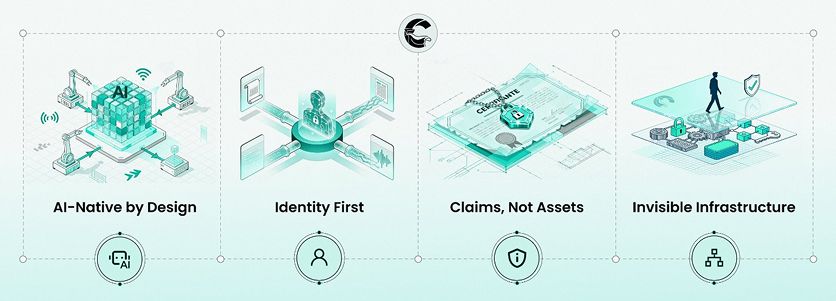
zCloak Trust Layer is built as foundational infrastructure, guided by four core principles:
2.1 AI-Native by Design
The system is engineered specifically for AI-generated content, autonomous agents, and machine-driven workflows—not retrofitted from legacy human-centric models.
2.2 Identity First
Trust begins with who makes a statement. Every claim in the system is cryptographically bound to a verifiable digital identity.
2.3 Claims, Not Assets
Authenticity, authorship, and ownership are treated as verifiable claims, not as static files, financial tokens, or speculative assets.
2.4 Invisible Infrastructure
Complexity should be abstracted. End users should not need to understand cryptography, distributed ledgers, or key management to benefit from strong trust guarantees.
3. What Is the Trust Layer?
The Trust Layer is a decentralized infrastructure for creating, verifying, and executing Verifiable Claims about digital entities.
It provides a universal answer to a single unifying question:
Who said what, about which digital object, and when—in a way that can be independently verified and programmatically consumed?
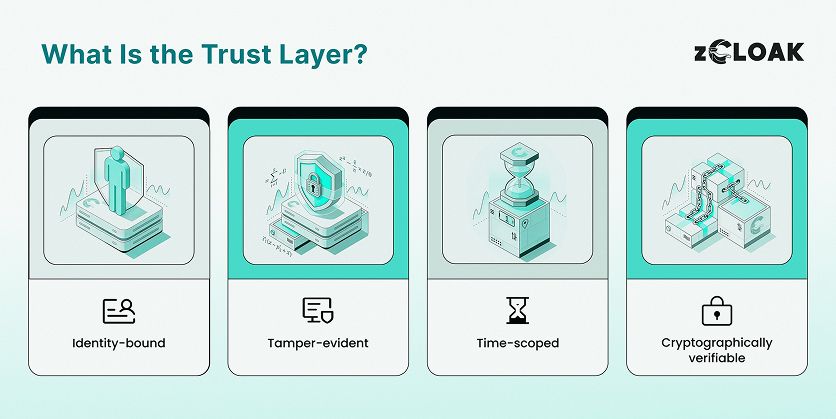
The Trust Layer does not act as a supreme court of truth or moral authority. Instead, it ensures that digital statements are:
- Identity-bound: Linked to a specific entity.
- Tamper-evident: Any alteration is mathematically detectable.
- Time-scoped: Anchored to a specific moment in time.
- Cryptographically verifiable: validatable without relying on a middleman.
This allows downstream systems—whether human, corporate, or automated agents—to make decisions based on endorsed data.
4. Core Primitives
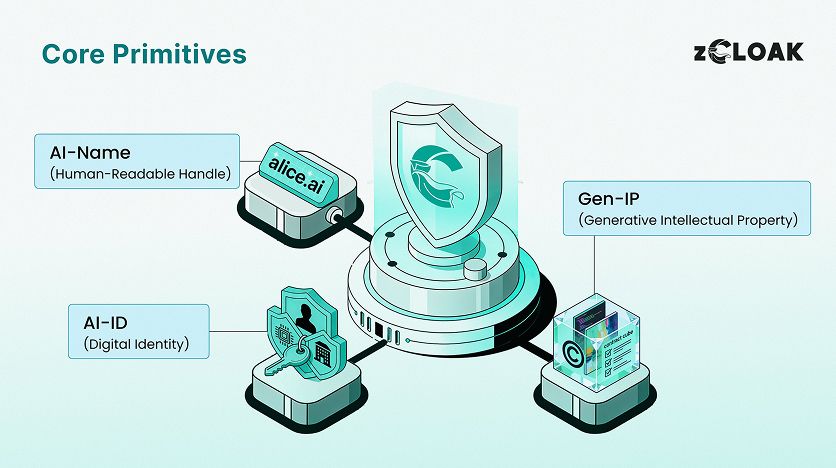
zCloak Trust Layer is built on three foundational primitives:
4.1 AI-ID (Digital Identity)
AI-ID represents the sovereign digital identity for:
- Humans
- AI Agents
- Organizations
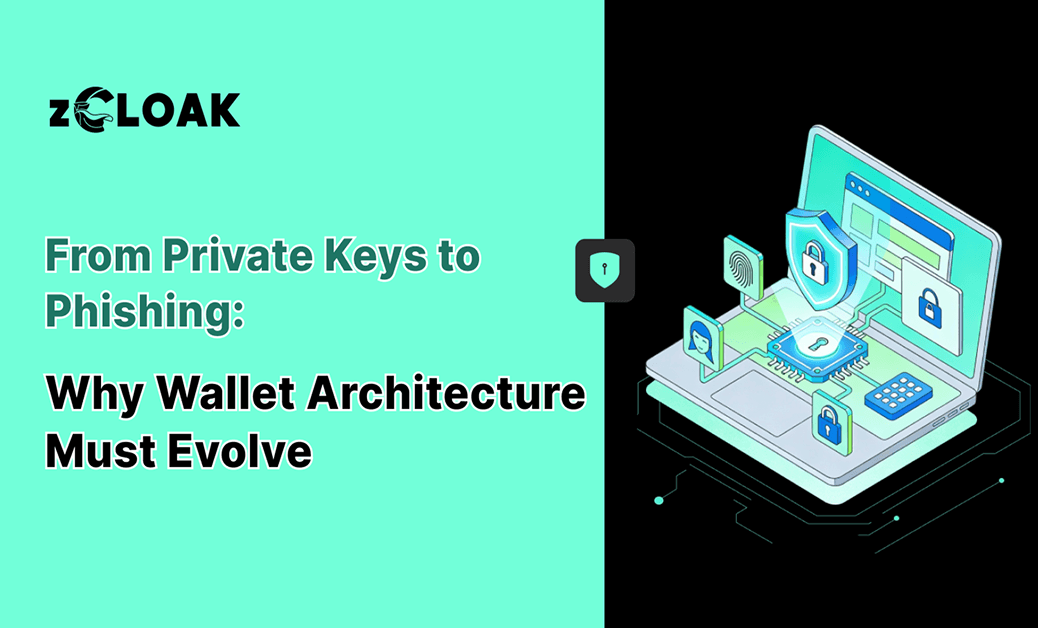
It is secure, persistent, and bound to strong authentication methods (such as Passkeys). AI-ID answers the most fundamental question: "Who is making this claim?"
4.2 AI-Name (Human-Readable Handle)
AI-Name is the recognizable identifier bound to an AI-ID (e.g., alice.ai, studio-x.agent).
It enables attribution, reputation accumulation, and social recognition across different platforms. It is designed for identity reference, answering: "How is this identity recognized by others?"
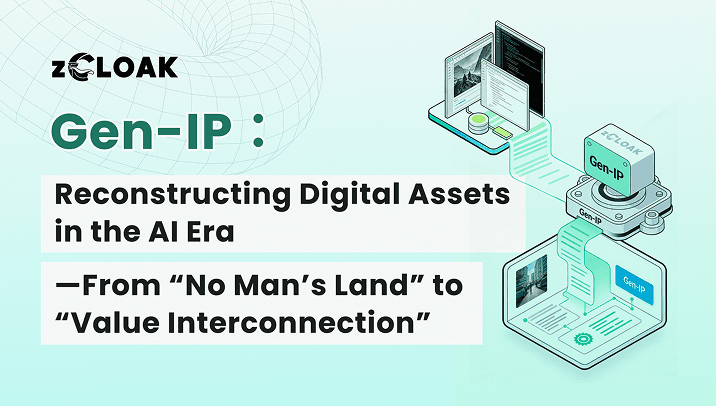
4.3 Gen-IP (Generative Intellectual Property)
Gen-IP represents the bundle of rights and ownership surrounding AI-generated or AI-assisted content.
Crucially, Gen-IP is not a file format or a financial instrument. It is a Rights Object, defined entirely by a set of cryptographic claims. It answers: "What rights exist around this creation?"
5. Claims: The Unifying Abstraction
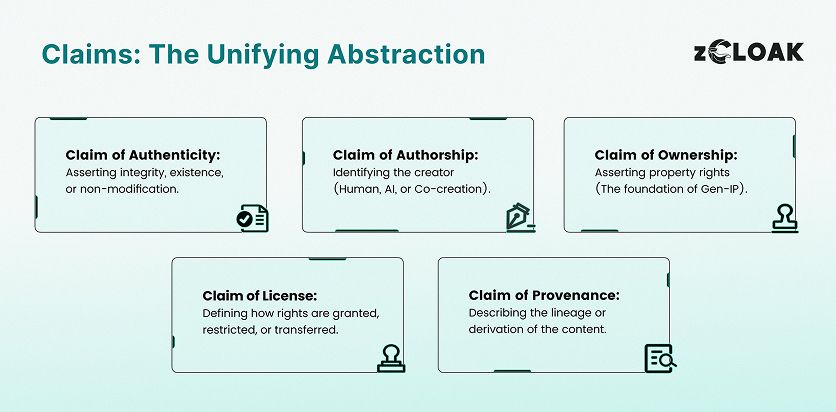
All functionality within the Trust Layer is unified through a single abstraction: The Claim.
A Claim is a statement made by an AI-ID about a digital object (identified by its hash), at a specific time, with a defined scope.
Attestation is the mechanism that makes these claims verifiable. When an entity Endorses a claim, they stake their cryptographic identity on its validity.
Core Claim Types:
- Claim of Authenticity: Asserting integrity, existence, or non-modification.
- Claim of Authorship: Identifying the creator (Human, AI, or Co-creation).
- Claim of Ownership: Asserting property rights (The foundation of Gen-IP).
- Claim of License: Defining how rights are granted, restricted, or transferred.
- Claim of Provenance: Describing the lineage or derivation of the content.
6. From Trust to Automation
The Trust Layer is designed to integrate seamlessly with execution and settlement layers.
- Automation Systems can consume verified claims as "If-This-Then-That" triggers (e.g., If provenance is verified, allow API access).
- Payment Systems can settle value transfer once claims are validated, utilizing familiar fiat rails or enterprise payment gateways.
By separating Trust (Verification) from Settlement (Value), the system remains modular, scalable, and legally compliant.
7. User Experience: Trust Without Friction
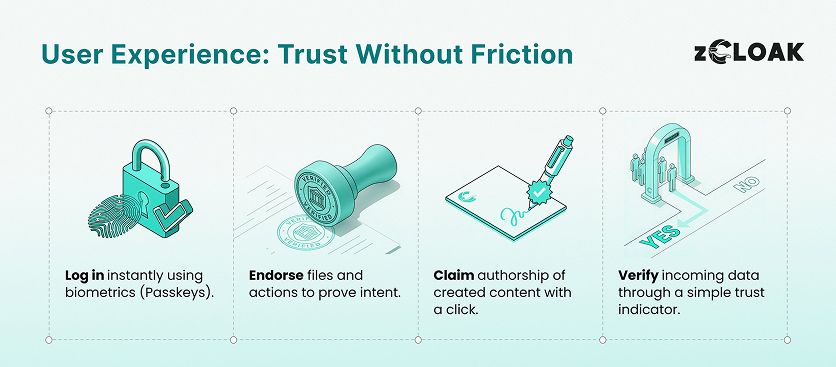
For end users, the underlying cryptography is invisible. The Trust Layer exposes only intuitive actions:
- Log in instantly using biometrics (Passkeys).
- Endorse files and actions to prove intent.
- Claim authorship of created content with a click.
- Verify incoming data through a simple trust indicator.
Whether the user is a human artist or an autonomous AI agent, the interaction remains seamless and low-latency.
8. What zCloak Trust Layer Is — and Is Not
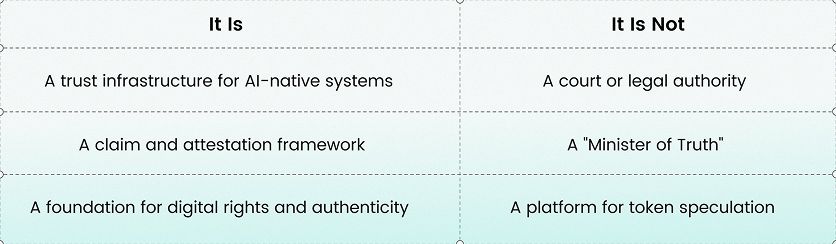
zCloak Trust Layer enables Verifiable Claims. How those claims are interpreted, valued, or enforced is left to people, institutions, and automated markets.
9. Vision
In the Age of AI:
- Content is abundant.
- Trust is scarce.
- Execution depends on trust.
zCloak Trust Layer provides the missing foundation—an AI-native, identity-based trust infrastructure for the digital world.